Wednesday, May 23, 2018

The 3 M's: Marge, Marriage, and Mayor

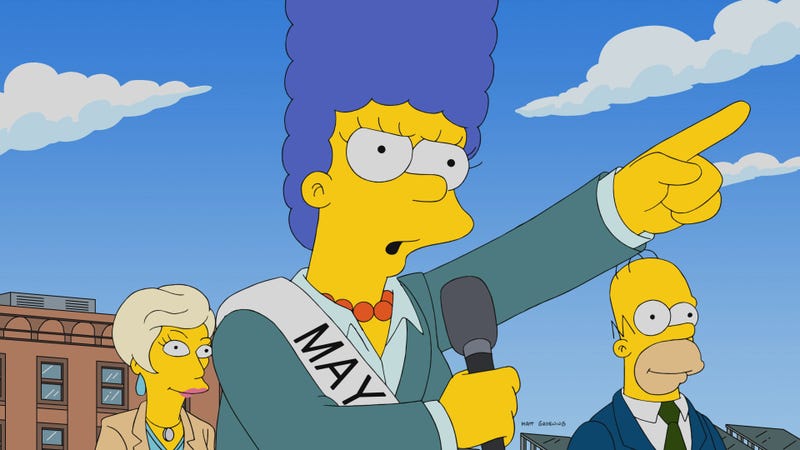
Image result for marge simpson as mayor


 In Season 29, episode 6 of The Simpsons, the feminist analysis is given tons of usage. In the episode Marge decides to run for mayor of Springfield after she is fed up with the way things are run. In the town hall meeting the first signs of sexism are present when the mayor puts down Marge for being a female by making sexist jokes. He makes comments about the difficulty of running a city is more complicated then getting her nails done. When she calls him out on his sexist comments, he continues to make more. In the next scene Lisa and Marge are in the kitchen talking about how society is still very much sexist and when she tells Homer she wants to run for mayor he says he is completely against a woman being mayor. 
The show continues its traditional values when Marge is asked what can she do for everyone in the town and she says as a mom she will have them eat their vegetables. Her position as a mom becomes at the forefront of the episode, the audience reacts by doubting her ability because she is a female and a mother. Even one of the women critics her baked dish she brought to the pta meeting instead of her as a politician.
 Even though she became the first woman mayor in Springfield it seems like the citizens of town, especially the media is down her throat watching every move she makes. They scrutinize her more harshly because she is a female expecting her to fail. When Marge tries to fix the problems around her by making a video of her in the kitchen, it reiterates that she can not get away from the “women are only good as mothers” stereotype. As she is filming Homer cuts in and ask her what time is dinner ready. When she tells him that she is in the middle of the speech, he disregards her and continues to ask the time. A few minutes later he comes back and ask her if it's possible to cook a hot pocket in the dryer. His lack of understanding for food preparation makes it seem as though women are the only ones who can successfully cook dinner and that it is not in men’s nature to be able to cook properly.
 After holding a focus group, her team that helped her get into office convinces her to use her husband's goofiness to raise her ratings. Throughout the rest of the scenes Homer is used as a comedy act next to Marge to boost her approval ratings. The show depicts that a woman in power is unable to succeed unless a man is involved. Marge is only able to increase her approval ratings by having Homer involved in her role as mayor even having a float of him being created for the Thanksgiving Parade.
 Later on in the episode, Marge goes to the former mayor and asks him if it's possible to have a good family life and be a political leader at the same time. This scene highlights what many women have to go through when it comes to balancing their lives. When a career woman who is also a mother is doing well, society feels the need to question whether she can balance both. Her personal life is tied to her professional one and people are unable to separate the two. Marge’s confusion on the balance is society’s pressure for her and other career woman to pick one life path instead of getting to enjoy both.
  The scene ended with the former mayor asking her to stay for an event because they needed coffee and cake served. This moment describes how as a woman no matter how professional you become, it is hard to escape society’s need to put you in domestic positions.

Saturday, May 5, 2018

Fuller House: Culture appropriation


Related image
    In the reboot show Fuller House, an episode in the first season outrightly suggest the use of cultural appropriation. The night episode of this season titled "Partnerships in the Night", focuses on DJ Tanner-Fuller throwing a retirement party boss. The boss, a veterinarian named Dr. Harmon is moving to India and DJ takes it upon herself to throw him an Indian themed party. Cultural themed parties aren't new and the producers of this show decided to take part in it as well. The party is filled with tons of people who appear to be white, with no Indian person showing up to the event.
    Exclusion takes place in this episode by removing any trace of an Indian person at an Indian themed party. The lack of representation from the very people whose culture is being appropriated emphasizes the constant need to annihilated people of color from the media. White attendees seem to be the only ones present at this party, reinforcing the white race as the dominant group even in a situation that is not of their culture.
Stereotyping is also in this episode, but is first seen when Kimmy tells Stephanie to go to Target and buy anything remotely Indian. By giving her these directions Kimmy suggests that Stephanie can go off of her own idea of what she think is Indian, leading to her stereotyping the cultural group. At the party they simplify Indian culture to just colorful garments and decorations, as well as phrases. They only show pretty images of what they think is Indian culture without educating the viewers and themselves on the meanings behind the garments, food, and decorations. To them they view the culture a a simply theme to only enjoy for one night, while excluding the very people a part of that culture.
     The episode ends with a group dance by the cast and extras. What makes this scene more appealing is that the people dancing are majority white, not hinting at a single Indian person. The show's audience applauds the cast while they are taking part in this traditional dance. It reiterates that white people are able to take an element of a culture group, use it for entertainment, and be congratulated for it as if them appropriating the culture is not up for ridicule. The boss congratulates Kimmy for organizing the event saying that she came up with the "happy dance" referring to the traditional Indian dance. By reducing the dance to just a dance for enjoyment, erases the historical context embedded in the culture's dance.
The episode received a lot of ridicule from when it first aired, but not as much as it should have. Its apparent appropriation of Indian culture shows that even today, shows do not fail to use cultural groups as pure entertainment.

Monday, April 23, 2018

That 70s Trope


That '70s Show Season 7 Episode 25 S07E25 (Last) HD Watch Online

When deciding on a show to use as an example of tropes I came across plenty of shows that include numerous tropes. One show that I find personally interesting and notice an obvious trope is That 70s Show. The comedy show which first aired August 23, 1998 describes six friends going through life in the 70s. Although each character is different in how they are depicted, one character that stands out to me is Jackie Burkhart.

Jackie entered the show as the youngest person in the group and in real life. Her age helped driver her character as the annoying rich girl in the show. She is depicted as the "Rich Bitch" trope meaning she is a wealthy young girl who views herself highly. Her superior attitude towards those around her affects how they view her. Jackie never fails to remind her friends how rich she is not only money wise but also socially. She uses her wealth to get what she wants and looks down on those who aren't of the same status as her. In the beginning of the show, the other characters continuously expressed how much they disliked her and never wanted her around. They persistently told her how rude she is and how she needs to change her personality in order for them or anyone to like her.

Her spoiled brat mentality affects her relationship with men because she constantly puts down guys who are not up to her standards and attempt to talk to her. In the show she is seen brutally tearing down these men and so many other characters. She feels as though her wealth will allow her to do whatever she wants with them and expects them to kneel at her feet. Jackie views her status as an excuse to be rude to men and use them in whichever way she wants.

The "Rich Bitch" trope embraces the cultural ideology that being rich also implies that you must be rude as well. It suggests that the wealth a person obtains requires them to use their power to not only get what they want but also put down others who are of lesser status than them. This trope also indicates that a rich woman is always meant to be mean and manipulative. Also that the woman is petty for no reason other than her own entertainment. It implies that by being rich, real friendships don't exist due to the amount of money you have.

Wednesday, April 18, 2018

Fresh Off The Boat

Image result for fresh off the boat
  The ABC tv show, Fresh Off The Boat, premiering 2015, made headlines with its authentic and comedic take of foreigners coming to America in the 1990s. The sitcom takes on an approach that isn't seen in most of our primetime television on air now. The shows comedic perspective on what it's like being a non white family migrating to the United States for the first time. By going through seven concepts that involve race, the show displays the truth of outsiders coming into a predominantly white run country.
     When discussing exclusion in terms of the show, the sitcom depicts many scenes that isolate the main characters from the white people. Eddie Yang, the oldest child in the family is excluded by his classmates at school all the time. He talks about how hip hop had become a safe haven for him when everyone else around him did not accept him.
     In the show, there are many scenes discussing how the family gets stereotyped. In one episode of the show, Eddie and his mom go to the principal's office. His mom argues to the principle that Eddie's homework is too easy and needs to be harder. This episode uses the "tiger mom" stereotype found in many asian moms when played in films or tv shows.
    Assimiliation is a big part of the show and by even watching the trailer anyone can see that the family is attempting to do just that. Throughout each episode the family, especially the dad, attempts to assimilate with the other families around him. By having a texan ranch restaurant to wanting to participate in activities he does not enjoy, the whole show uses assimilation as its main joke.
   In many of the episodes, Louis Huang, the dad, becomes the token asian friend with people around him. His white neighbors or friends use him as a reference to say they have an asian friend. The show itself does not unconsciously use the token asian as a real thing for them.
   Regarding ideology of difference, the show does not depict ideology of difference in a way that is clear and apparent.
  There is a sense of mothering that takes place in the show, because there are times the family as a whole or an individual family member will be excluded by whit people around them because they are too different.
  The show also depicts exotiscm because of the kind of pleasure some of the q=white characters get from witnessing an Asian family around them. There has been many times the family has been asking racist questions by white characters who immediately get excited and interested if their prediction  is right.

Tuesday, April 3, 2018

Midterm Question


5 ways The Simpsons satirizes workers/unions:

1. Workers willingly giving up dental plan for a keg satirizes how workers can seem like they're not passionate about their well-being

2. Homer thinking he's a better negotiator then Mr. Burns but ends ump trading his danish with bart's doorstopper

3. The workers are seen as violent and aggressive during their strikes by hitting police cars and beating people up who don't agree with them

4. Homer leaving a strike to get food shows don't find their rights as that important

5. The employees putting Homer as the leader even though he has no experience, shows that they lack the knowledge of electing a good fit leader

5 ways The Simpsons satirizes management/owners:

1. Mr. Burns hired goons to intimidate Homer with power in order to have him back down

2. Burns not remembering who Homer is even though Smithers list all the time he has helped Burns and the plant

3. Burns hiring an immense amount of monkeys and overworks them giving them poor working conditions just to write his novel

4. Mr. Burns tries to run the plant himself when all the workers go on strike but it proves to be a failure

5. Mr. Burns cuts everyone's power off from his frustration with the workers on strike


The episode affirms ideology of capitalism

In this episode of The Simpsons titled "Last Exist to Springfield", the scenes and characters were able to normalize and affirm the ideologies of capitalism. The episode was focused on union workers feeling like they didn't have the rights they wanted and fighting to keep them. In the show, Mr. Burns represents the powerful and rich owners who control large amounts of people. Not only does Mr. Burns own his employees but he also controls the people of the town by providing them with electricity, an important necessity. As soon as he gets frustrated, Burns is able to use his power and wealth to cut off an important need of people, by simply clicking a button. The show also affirms capitalistic ideologies when we look at Lisa's braces situation. When Lisa is in need of braces, the dentist gives her two options. One being the fancy and nice looking braces that are expensive, and the other being old, dirty, and scary looking braces that are more affordable. Due to the lack of money in her household, Lisa has to go with the more affordable braces. This option reaffirms capitalism that by spending more money, you will only get the best, and if you don't contribute to that you will only get the worst.

The episode challenges the ideology of capitalism

This episode of The Simpsons challenges and interrogates capitalism in many ways. It's big picture message states that with perseverance and determination, workers can fight against big owners and companies just by sticking together. This is shown throughout all the strikes in this episode. Homer becomes the leader of the union and he succeeds in getting the demands the workers want. He began this challenging of capitalism by denying the consumption of free beer in order to not fight for their rights. By doing so, he immediately let Burns know that he cannot buy the workers out just to stop fighting for their rights. As the strike continues, Mr.Burns gets more and more frustrated, leading him to attempt running the plant by himself. Once Burns is put into the shoes of the workers and sees how difficult it is to work at the plant, he gives up and tries a new tactic. He decides to turn off all the electricity for the town. Instead of the strikers giving up as capitalistic society would expect them to, they continue to stand their ground. Their unwillingness to budge causes Burns to realize he was in the wrong and could use his wealth and power to influence the workers.


Wednesday, March 7, 2018

Infected By Cultural Studies


I have always for the most part watched television and indulged in any sort of media for entertainment purposes only. The 90% of time I spend enjoying media outweighs the 10% of time I take to actually analyze the things I am consuming through different mediums. However, after learning about Cultural Studies, the way I view media has shifted greatly. I no longer spend more time purely enjoying the content, but take time to analyze what I am watching. My mind has changed from just a viewer perspective, to multiple outlooks on the media. I am now able to understand the creator's intent for producing the content they choose for the viewers to watch. Each type of media has its reasoning for being produced and is meant to formulate the audiences opinion on something.


My new way of decoding media was really seen when I was watching the show Atlanta, created by Donald Glover. In the particular episode I was watching Earn is held in jail for the night. Throughout his time in prison we see his experience while being confined. The police are present to keep things in order and act as responsible figures. While watching I realized that the ideologies present in this episode reflect the cultural ideologies that police do no wrong and are primarily present to keep things in order because they do not cause chaos. In the episode a man in jail is pinned down and attacked by the police for no reason and the rest of the characters dont seem to question it. I continue to analyze that the doxa present in this episode is that its common sense to not interfer when a police officer is having a situation with another person, no matter if that person is in the wrong or not. This is just one example of how I have begun to break down media after learning about cultural studies.

Tuesday, February 20, 2018

It's (Not) Always Sunny in Philadelphia


  In the hit comedy show, It's Always Sunny In Philadelphia, crazy antics and adventures take place throughout the twelve seasons of the series. The cast of a family and two childhood friends entertains the audience with various amounts of episodes that are not only hilariously funny but also point out moral and political issues our society faces. This show is a good example of what a satire should look like with constant hinting to controversial issues. A satire is known to have comedic base with a splash of emphasis on moral goodness. It's Always Sunny In Philadelphia does just that throughout the series, by being able to call out certain immoral and inappropriate aspects of society. The creators of the show do this in a way where the characters aren't aware of their intended mentions of political issues or their effectiveness once its said. This creates an easy flowing stream of satire that the audience are able to understand on an intellectual level.
  Another key aspect of It's Always Sunny In Philadelphia, is the nihilism present in the series. This show takes on a different path compared to the popular sitcoms airing or have aired while the show has been on air. An avid watcher of the show could make the observation that the show is half satirical and half nihilistic. The wildness that goes on in the show is due to the characters' ideologies and how they, most of the time, view life as meaningless. They tend to take on a more pessimistic perspective by immediately shifting to a negative conclusion prior to even solving a problem. Each character has gone through an episode where they have had a cynical view on an event occurring in their lives. The other characters fueled these cynical thoughts by either agreeing or adding on to the negative thoughts. This is usually how the relationships in the cast goes due to the lack of empathy, hopefulness, and care of others and the world around them. This leads the characters' lives to have no progression or growth throughout the series. A good example of this is the lack of success the bar has compared to other businesses around it.
  In one episode of season nine of the show, the self-titled gang (Dennis, Dee, Frank, Charlie, and Mac) go to a bar that has won muliptle awards for being of top quality. As they look around at the lively, well lit and clean bar, they begin to wonder why their own bar hasn't received the same amount of success. As a constant watcher of the show, you would quickly be able to understand why their bar has not gained any popularity. The dark, unclean and very unpleasant workers of their bar are to blame for the lack of customers. This is due to the characters unwillingness to care for anything but themselves while keeping a despairing point of view.
  The series as a whole beautifully incorporates nihilism in an already satirical setting without the overspilling of one onto the other. The balance of the ability to point out political issues in a way that calls out the wrongdoings of society, while still keeping the characters' personality as cynical and nihilistic is the reason why the show is able to be on for twelve seasons.

Wednesday, February 14, 2018

Roseanne and the Marx


      Although Karl Marx’s theories were formulated in the nineteenth century, his ideals still are true and exist till this day. One way we can see this is in the media and how they portray class. The media does a very good job at bringing up marxist theory in either tv shows or movies.In the episode of Roseanne titled, Let's Call It Quits, a critique that supports Marxist criticism is pretty evident if the audience analyzes the episode. In Marxist criticism, there are three classes, Aristocrats, Bourgeois, and Proletarians. 
In this episode of Roseanne bourgeois is seen in form of the supervisor and proletarians is present in the form of roseanne and her co workers. The proletariats work at a plastic manufacture and are of the working class. At the beginning of the episode the proletariats (roseanne and her friends), support marxist criticism by stating what the supervisor really deserves is to have to work for himself. By bringing attention to the lack of work done by the bourgeois (the supervisor) and the proletariats, this episode emphasized the disparities between economic classes.
Later on in the episode, the supervisor interrupts the girls lunch break by asking them if they are enjoying their break. Roseanne and one of her coworkers jokingly says that they are enjoying their imaginary veil and other fancy meals. Their mocking focuses on how they portray the upper class to act when they do not have to work for their earnings. Since the girls have not experienced such lavish living due to their economic status, they create an imaginary scenario on how they think they would be living. 
Another instance that supports Marxist criticism in the episode is when Roseanne decides to clean up her friend’s workplace, because the supervisor believes it’s too messy. As the supervisor is attempting to stop her from doing another coworker’s work, Roseanne refuses. This reflects the ideology present in Roseanne and other proletariats. The notion of sticking together and working as a team is a long time ideology of the working class since they have been the largest group for ages. Roseanne’s ideology is attempting to be halted by the supervisor’s own ideology. His beliefs stem from his position as a bourgeois and the notion that things should be done independently.
One key scene in the episode is when the coworkers are at the bar for the first time. While at the bar, one of Roseanne’s coworker complains about the unfair pay and the unrealistic expectations they are given. The supervisor gives them a goal that is too difficult for one human being to do in such a short amount of time. For the girls (proletariats), they are able to criticize the class system because they are being treated unfairly by it. However for the supervisor, since he receives plenty benefits with little hard work, he is unable to criticize the economic system he is on top of.
Towards the end, Roseanne finally quits realizing that she is unable to reason with someone economically above her. When the supervisor tries to remind her of this she makes the decision to quit her job. The supervisor warns others in the cafeteria that they can choose to stay and make money, or leave and quit. After this statement, Roseanne’s coworkers begin to get up and quit. The ending part to this episode emphasizes that the proletariat are able to use marxist criticism in situations like these.

Thursday, February 1, 2018

White Fragility in the Workplace: How does this apply to Critical Media Studies


       This popular video posted by AJ+ discussing white fragility in the workplace is a great piece of media to analyze. As a media scholar this video gives me various theories and concepts that are talked about in the book. One outstanding theory is the Political Attitude that is featured in critical media studies. The video points out that white people have more privilege than those of color, and by using satire they emphasize the power structure in our society today. The comedic approach to white sensitivity to racial topics, sets up a political attitude for the entire video.
       Another aspect of the video that is included in the book is the social justice perspective. By poking fun of white fragility from being called a racist, an awareness of inequalities faced in the workplace by people of color is added. The point of the video is to make white people understand that  being labeled a racist isn't as hurtful as the oppression people of color go through daily. To put a term equal to systematic oppression faced by non white people is invalid. The video makes this point across by adding comedy to the subject. By making the audience laugh it will exaggerate just how ridiculous white fragility is.